

Remote-sensing Assessment of Heritage Sites in the Gaza Strip up to December 2025
Satellite imagery analysis of heritage sites across the Gaza Strip by the EAMENA project was undertaken to provide an assessment of site conditions across this area up to December 2025. This interim study examines 524 architectural and archaeological heritage sites recorded in the EAMENA database and will feed into a partnership funded by the British Council’s Cultural Protection Fund with Palestine’s MOTA-DACH, the Centre for Cultural Heritage Protection (CCHP) and local partners to monitor a smaller number of key sites which will include detailed ground assessment where viable. The present study indicates widespread damage across the Gaza Strip, with extensive damage issues continuing after the 3 October 2025 ceasefire.
Methodology
The visual assessment was carried out using high-resolution satellite imagery generously provided by Planet Labs. Each site was examined individually and assessed at one of the following five grades depending on the visible scale of damage on satellite image: Good; Fair; Poor; Very Bad; Destroyed. The final option of ‘Destroyed’ is used sparingly as it implies the complete removal of a heritage site which would not warrant investigation during any future reconstruction phase, whereas even in examples such as buildings that have largely been demolished there are likely surviving foundations, architectural fragments and potential sub-surface archaeological deposits surviving. The grade ‘Very Bad’ is therefore used even in cases where a heritage site has been devastated. A sixth grade of ‘Unknown’ refers to cases where it is not possible to make an assessment, usually in cases where were recorded on historic mapping but were unknown whether they were preserved in any form prior to 7 October 2023.
This assessment should be considered provisional. For instant the dataset developed by the EAMENA project has come from a range of sources and it has not always been possible to verify the exact location coordinates of each individual sites, particularly among the dense concentration of historic buildings in the historic core of Gaza City, so there is the risk that the incorrect structure may have been assessed. It is also not possible to systematically record small-scale damage issues via satellite imagery, issues related to contamination, or the types of deterioration that may have occurred as building maintenance has been prevented by the conditions in the Gaza Strip since October 2023. It is also not possible to assess the damage that may have been caused to sub-surface archaeology by the construction or demolition of militant tunnels across the Gaza Strip.
Results
The assessment of the Gaza Strip of the 524 heritage sites up to the December 2025 breaks down to the following grades:
Good 51
Fair 49
Poor 91
Very Bad 281
Destroyed 36
Unknown 16
The figures make clear the scale of damage to heritage sites across the Gaza Strip, with only 100 sites out of 524 being graded as ‘Good’ or ‘Fair’. Except for a small number of outliers, these better-preserved sites are largely concentrated in the historic centre of Deir al-Balah and in the centre of Gaza City, particularly the south-western half of the old town.
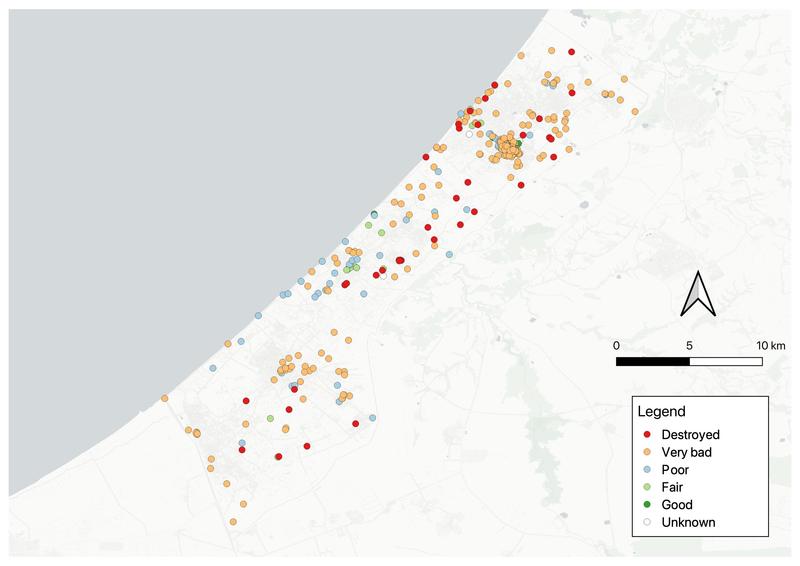
Figure 1. Map showing heritage site conditions across the Gaza Strip. Basemap source: Positron.
The results reflect a static assessment of the condition of heritage sites up to early December 2025. During the recording process it was noted that even after the official ceasefire declared for 3 October 2025 a systematic process of demolition has been continued by Israeli forces east of the Yellow Line in the eastern suburbs of Gaza City. This area, which has the highest concentration of heritage structures in the Gaza Strip outside of the historic core of Gaza City, had already been badly damaged in earlier stages of the conflict, but has now been subject to extensive levelling.
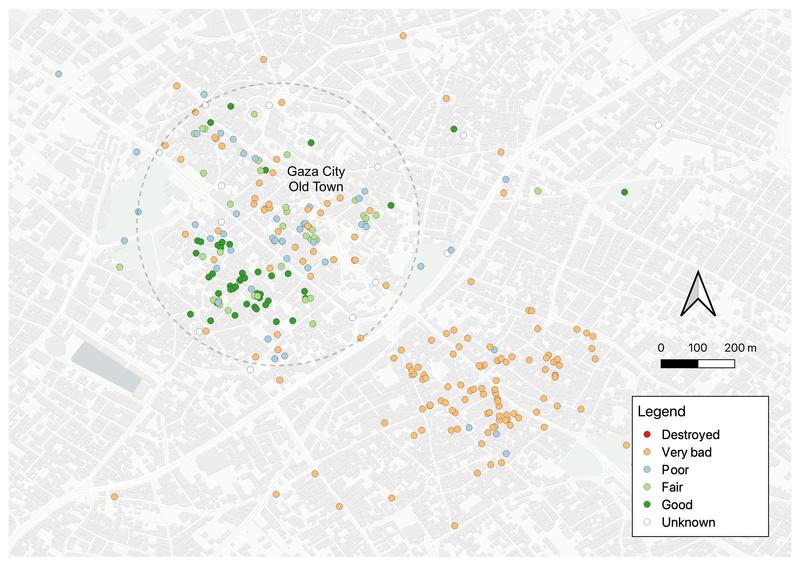
Figure 2. Detail showing condition of heritage sites across Gaza City, with the historic core to the north-west and the historic suburbs to the south-east. Basemap source: Positron.
Acknowledgements
We are grateful for to Planet Labs for supplying satellite imagery, and to the MOTA-DACH, CCHP and the MarEA project for support in collating site data.

