

Iran’s Endangered Urban Heritage: Monitoring Conflict Damage Using Sentinel-1 and OpenStreetMap
As regional conflict continues to pose a threat to the cultural heritage of the Middle East, the ability to monitor heritage sites in near-real-time using satellite imagery has become a conservation priority. Building on our previous automatic change detection work in Gaza (Deadman 2024), we have refined our monitoring tool for urban heritage, and here we present the results for the historic centres of four major Iranian cities: Tehran, Isfahan, Kermanshah, and Sanandaj.
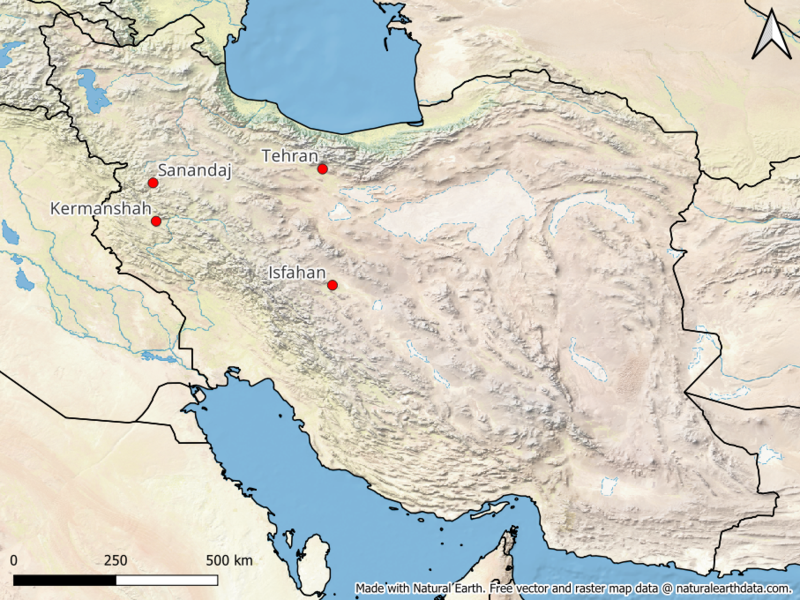
Initiatives such as Middle East Cultural Heritage at Risk in Armed Conflict — led by the University of Chicago’s Center for Ancient Middle Eastern Landscapes in collaboration with the Society of Iranian Archaeology — provide a geospatial database of heritage sites and historic landmarks damaged in recent armed conflict (CAMEL 2026). EAMENA has been collaborating with this project, but our automatic change detection approach focuses on city centres in order to capture broader changes in urban areas, which also include historic buildings.
Four historic Iranian cities
Tehran became Iran’s capital under the Qajar dynasty in 1789, and its historic core preserves important traces of Qajar, early modern, and Pahlavi urban development. Around the Grand Bazaar, Golestan Palace, and the old Arg district are historic houses, caravanserais, mosques, churches, synagogues, and traditional neighbourhoods such as Oudlajan and Sangelaj, many of which face pressure from redevelopment.
Isfahan is one of Iran’s most celebrated historic cities. As the Safavid capital from 1598, it developed an extraordinary urban landscape centred on Naqsh-e Jahan Square, the Grand Bazaar, major mosques, palaces, gardens, bridges, and historic neighbourhoods such as New Julfa. Its UNESCO-listed monuments and dense historic fabric make it a key case study for urban heritage monitoring.
Kermanshah’s heritage reflects its position in the western Zagros and its long history from the Achaemenid and Sasanian periods to the Qajar era. Nearby Bisotun and Taq-e Bostan are internationally significant rock relief landscapes, while the city itself contains bazaars, caravanserais, mosques, religious buildings, and historic neighbourhoods showcasing Kurdish cultural life.
Sanandaj, capital of Kurdistan Province, developed as a regional centre under the Ardalan dynasty from the seventeenth century onwards. Its historic core includes Qajar-era mansions, the Jameh Mosque, the bazaar, courtyard houses with orosi windows, and cultural traditions such as Kurdish music, craft production, and the daf instrument.
These cities represent some of the most significant historical and cultural hubs in the region. To document potential impacts on their cultural, historical and religious resources, we have deployed a refined Synthetic Aperture Radar (SAR) analysis that combines the speed of Google Earth Engine (GEE) with the crowd-sourced detail of OpenStreetMap (OSM).
Synthetic Aperture Radar and urban conflict
While more familiar multispectral imagery like Sentinel-2 can be used to great effect to detect change in areas of archaeological interest, as demonstrated by the EAMENA team in Leicester (Mahmoud et al. 2025; Rayne et al. 2020), Synthetic Aperture Radar (SAR) is particularly useful in urban areas. SAR uses radio waves rather than visible light, and buildings reflect these waves strongly. When a structure is damaged or altered, the signal drop is immediate and measurable. Moreover, if a previously flat area becomes either covered in rubble, debris or cratering, this is likely to show a signal increase, as these are better at reflecting radio waves. The radio waves used in the Sentinel-1 SAR system can also easily penetrate cloud or dust, and the satellites can operate during the night, allowing more images to be taken. Over most of Iran, Sentinel-1 has a regular revisit cycle with each satellite returning to exactly the same position every twelve days. However, as the SAR images are so large, all four cities are visible from at least two different orbit tracks, allowing change to be monitored in near real-time. Moreover, western Iran is covered by two S1 satellites, S1A and S1C, cutting the combined revisit time to six days.
Our method uses a moving window that calculates a median of the latest three images taken from the same position. Raw SAR images are noisy, so calculating a median produces cleaner results with less risk of false positives. Each median image is then compared with another calculated from the last three images taken before the start of the conflict on 28/02/2026. The result is a third image showing the difference between the before and after images. Any pixels with little to no change are masked, so only areas of significant change (± 2.5σ) are shown. The precise methodology will be published in a future paper.
|
City |
Pre-conflict Image |
Conflict Image |
|
Tehran |
2026-02-19 (S1A) 2026-01-26 (S1A) 2026-01-14 (S1A) |
2026-04-20 (S1A) 2026-04-08 (S1A) 2026-03-27 (S1A) |
|
Isfahan |
2026-02-26 (S1A) 2026-02-14 (S1A) 2026-02-02 (S1A) |
2026-04-27 (S1A) 2026-04-15 (S1A) 2026-04-03 (S1A) |
|
Kermanshah / Sanandaj |
2026-02-23 (S1C) 2026-02-17 (S1A) 2026-02-11 (S1C) |
2026-04-24 (S1C) 2026-04-18 (S1A) 2026-04-12 (S1C) |
OpenStreetMap for cultural and historical assets
OpenStreetMap (OSM) is a free, and openly licensed geographic database of the world, built and maintained by a global community of volunteers. It resembles Google Maps or Apple Maps, but unlike these closed, proprietary systems, anyone can freely access, edit, and use its data. We exported OSM data for the four city centres, grouping them by existing OSM tags, and creating three simple categories:
- Historical: any record using the “historic” tag.
- Cultural: any record where the “tourism” tag is “museum”, “artwork” or “gallery”, or where the “amenity” tag is "theatre", "arts_centre", "library", "cinema" or "community_centre".
- Religious: any record where the “amenity” tag is "place_of_worship"
This rapidly provides a detailed dataset of cultural and historical assets in our areas of interest.
Detected change in Iran’s historic city centres
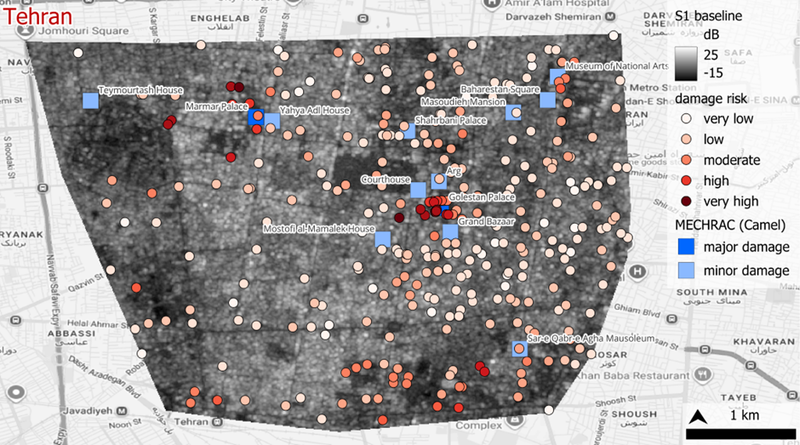
Tehran’s historic centre shows clear indications of significant change. There are around ten patches that show major signal loss, consistent with severe damage or destruction of buildings. These are concentrated in the central and northwestern areas. These results correspond well with other sources, particularly the Institute for the Study of War’s interactive map of strikes (ISW 2026).
The evidence for conflict damage in the three other historic city centres is much less clear. All show some strong background readings, but these are just as likely to represent a combination of the natural variations of ‘normal’ city life (traffic etc), and the Iranian response to strikes and measures to counter potential internal unrest (the installation of military equipment and checkpoints etc). This is in broad agreement with other sources, with strikes on these cities concentrated on military and industrial targets on the outskirts (ISW 2026).
Cultural and historical assets at risk
This analysis certainly suggests that Tehran’s cultural and historical assets are at the most risk. Compared to the Heritage Watch data (Camel 2026), which records individually geolocated damage to specific monuments, our city-centre approach captures a broader picture of urban impact. The two methods are complementary: Heritage Watch confirms damage at the level of named landmarks, while our analysis highlights wider changes to the dense concentrations of historical, cultural, and religious assets that characterise Tehran's urban core.
Conclusion
Our results suggest that Tehran’s historic centre is currently the area of greatest concern among the four cities examined. More importantly, the analysis shows how SAR-based change detection can support rapid heritage monitoring during conflict, especially when access on the ground is limited.
This approach does not replace site-level documentation. Instead, it complements initiatives such as CAMEL’s Heritage Watch, which records damage to specific monuments and landmarks. By looking across whole historic city centres, SAR monitoring can help identify broader patterns of urban change and highlight places where cultural, historical, and religious assets may need urgent follow-up assessment.
For anyone interested in learning more about the use of advanced remote sensing in archaeology, we have developed a free online course available in English, Arabic and Farsi.
Acknowledgements
Sentinel-1 data used courtesy of the European Space Agency. OSM data courtesy of OpenStreetMap. Data processing carried out with Google Earth Engine, and maps created with QGIS.
References
Camel. 2026. Middle East Cultural Heritage at Risk in Armed Conflict. https://heritagewatch.camelab.net/. Accessed 17/04/2026.
Deadman, W. 2024. Endangered Archaeology in Gaza: an automatic change detection system for archaeological sites and built heritage. https://eamena.web.ox.ac.uk/article/endangered-archaeology-gaza-automatic-change-detection-system-archaeological-sites-and-built.
Institute for the Study of War. 2026. Interactive Map: U.S. and Israeli Strikes in Iran. https://storymaps.arcgis.com/stories/089bc1a2fe684405a67d67f13bd31324. Accessed 17/04/2026.
Mahmoud, A.M.A., Sheldrick, N. and Ahmed, M. 2025. A novel machine learning automated change detection tool for monitoring disturbances and threats to archaeological sites. Remote Sensing Applications: Society and Environment 37: 101396. https://doi.org/10.1016/j.rsase.2024.101396.
Rayne, L., Gatto, M., Abdulaati, L., Al-Haddad, M., Sterry, M., Sheldrick, N., & Mattingly, D. 2020. Detecting Change at Archaeological Sites in North Africa Using Open-Source Satellite Imagery. Remote Sensing, 12(22), 3694.https://doi.org/10.3390/rs12223694.

